

Learn about different seismic performance categories, qualification and ideal design approach for designing anchors under seismic conditions
Seismic Performance Categories & Testing Processes:
Before covering the design approach, let us briefly examine the testing process that splits the anchor performance under seismic conditions into two sub-categories – C1 & C2. According to ETAG 001: Annex E, anchors tested to the first category, C1, must successfully sustain pulsating tension and alternating shear loads that are 50% of the total design load when set in 0.5mm wide cracks. The evaluation parameter is the residual load capacity of the anchor. As illustrated in Table 1 below, this category is best suited to non-structural, non-critical applications that do not jeopardize occupant safety.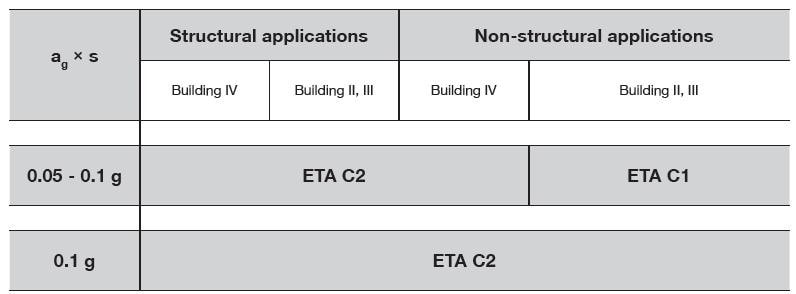
Table 1: European Seismic Category for Anchors (Note: Building Categories II, III, and IV rank in order of importance according to Table 4.3 of Eurocode 8 and s∙ag is the peak ground acceleration)
Category C2 is more stringent of the two; here, the anchor must sustain reference tension and shear tests in low and high strength concrete on top of sustaining the tests required by Category C1. Moreover, the anchor must perform under intense cyclical opening and closing of crack widths up to 0.8mm with applied loading at 85% of the total design loads. An additional evaluation parameter, on top of the residual load capacity, is that the anchor displacement must be less than 7mm.
However, the pre-requisite to conducting the tests is that the anchor must first be approved for cracked concrete (with 0.3mm crack width), otherwise it stands no chance of safely functioning under the cyclic opening and closing of cracks under Category C2. This Category completely alters the performance of the anchor and anchor group compared to a condition with static loads.
Limit State Design and Conceptual Design Approaches:
Simple qualification of anchor in the appropriate seismic category is NOT enough to guarantee safety under seismic conditions: Designing these anchors according to the limit state design concept is equally important.
Merely increasing the design loads by additional partial safety factors can lead to unsafe connections.
To amplify the characteristic to design loads, use is made of relevant load combinations obtained from the codes and the values obtained from calculations. However, the base plate's behavior in relation to the loads applied can vary depending on the base material’s behavior. Thus, there are three conceptual design approaches available for engineers – (i) Capacity design; (ii) Elastic design, and (iii) Ductile anchor. 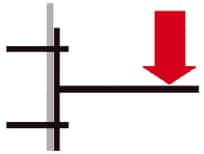
Figure 2: Elastic Design approach
Approach (ii) is the only one that allows brittle failure in seismic design and this design option assumes no energy dissipation in the entire structure and that each component can stay within its elastic range under seismic conditions. Being a more conservative approach, it accounts for the brittle nature of concrete, which will mostly fail before either the anchor (Ductile Anchor) or the member, typically steel, attached to the base plate (Capacity Design). This option amplifies the loads to correctly reflect the seismic loads acting upon the structure.
Following this approach allows comparison of the design loads with the design resistance and results in an engineered approach to designing post-installed anchors in concrete. Hilti’s PROFIS Anchor software allows engineers to resolve these calculations rapidly with great ease and flexibility. Our technical team is trained to provide you with guidance on designing and selecting the right anchors according to the right connections under the right loading conditions so no matter where your post-installed connection sits, you can be assured that your structure will have the highest level of safety we offer.
For further information or questions, please leave a comment and we will get back to you.
