

Know about some prevalent misconceptions and the importance of designing an anchor under seismic conditions
Introduction:
As a country susceptible to major earthquakes, India requires its buildings to have good resistance against this phenomenon so that the occupants’ safety is ensured. Keeping this idea in mind, existing codal provisions provide structural engineers with the necessary guidelines to design various structures. The codes – IS 1893 & IS 13920 – were updated recently in 2016 to allow newly and retrofitted constructions to better withstand seismic-induced actions.
While the analysis and design of newly-built and cast-in situ structures are well-understood by the engineering community, retrofits and post-installed systems are a niche requiring the sound judgement and visualization abilities of the structural engineer, in addition to specific guidelines. Until recently around the world, post-installed anchor connections lacked the necessary framework and guidelines that the engineer could use to confidently design such connections.
The lack of such guidelines no longer exists, particularly when following EC2-Part 4 (expected 2018), owing to advances in research. In India, however, no such codal provision exists and this has resulted in a lax approach to these connections and their design often relies largely on engineering judgement. In line with a global shift towards performance-based design, NBC 2016 has made some recommendations of ensuring that non-structural, but critical, building components withstand earthquakes. For instance, Clause 12.5.4 from Part 8 of NBC 2016 are included below:
Common Misconceptions Regarding Anchor Design under seismic conditions:
Before proceeding with designing post-installed anchor connections to withstand seismic-induced actions, it is important to clarify a few misconceptions:
1. It is not my responsibility but the anchor manufacturer’s.
2. There is no requirement of design since it is not mandated by any IS code.
3. I am applying an additional safety/load factor on my design loads.
4. I am applying a safety factor to an anchor manufacturer’s data.
The IS codes presently may not have any design method to calculate and design anchor resistances but allow reference to existing specialist codes and literature. A structural engineer needs to ascertain that post-installed anchor connections, in both primary and secondary members, will perform when subjected to seismic loads as their failure can have fatal consequences for that building’s inhabitants.
When using an anchor not qualified for use under seismic conditions, it will not perform according to the loads to which they are subjected. The cyclic opening and closing of the cracks will cause an unexpected performance loss and unacceptable behaviour, leading to premature anchor failure. No amount of over-strength designing through additional safety or load factors will compensate for this.
When using an anchor approved for seismic conditions, a proper design of a group of anchors still needs to be undertaken to ensure the safety of the entire connection. Again, simply applying additional safety or load factors does not guarantee adequate performance or acceptable behaviour. It is important to design the connection and not just rely on load tables that are applicable only for single anchors.
Design basis of Post-installed anchor connections:
In the absence of local guidelines, Euro Codes and EOTA can be referred. Under seismic conditions, methods described in EC8 allow evaluation of seismic actions and the structural response to these actions, while EC2 defines the design methods and resistance of the concrete members to seismic actions. IS 1893 and IS 13920, following the limit state design principle, allow calculation of design actions and resistances respectively.
Similarly, for anchors, the EOTA TR045 enables engineers to design their post-installed anchor connections.The selected anchor's characteristic capacity is found in its respective ETA, which is obtained only after the anchor performs suitably in tests and qualifies for seismic conditions as detailed in ETAG 001: Annex E. This is summarized in the following diagram: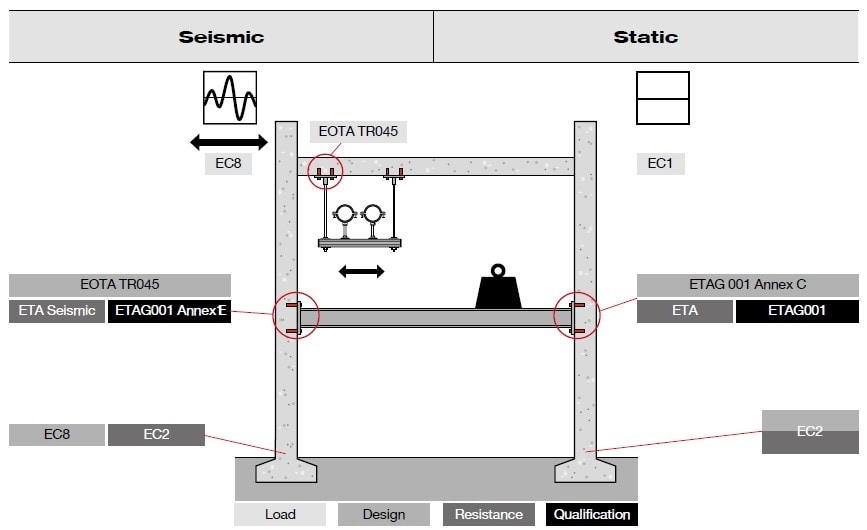
Hilti offers designers and structural engineers full guidance on selecting and designing the right anchors according to the right connections under the right loading conditions so no matter the location or the loading, you can be assured that your structure will have the highest level of safety.
For further information or questions, please leave a comment and we will get back to you.
