

Understanding the importance of designing an anchor under seismic conditions
Owing to the tremendous hazard posed by earthquakes, the design of structures to resist seismic actions has been the subject of intensive research and field investigations over the past half century. While much attention has been focused on the global response of structures and their analysis for earthquake loading, it is also recognized that good seismic performance is equally dependent on robust connection design. The design of anchorages used to transfer earthquake loads between steel and concrete elements represents an essential part of ensuring a continuous load path for inertial forces generated in a structure.
Examples of typical anchor applications found in both seismic and non-seismic regions, as well as some other application related to seismic strengthening and rehabilitation of structures are listed as follows: -
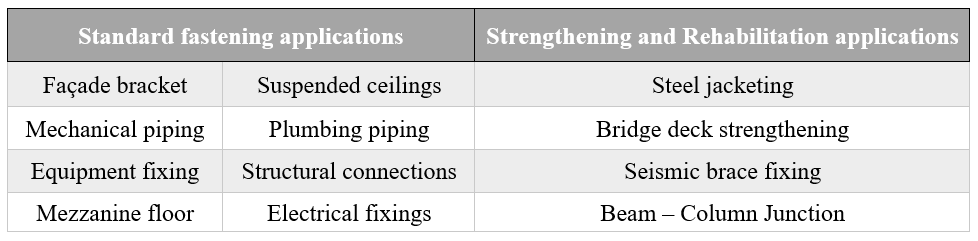
When discussing anchorages for seismic applications it is important to distinguish between structural and non-structural applications, since different load parameters and factor of safety need to be considered for each case.
In current practice, it is regrettably the case that many connections intended to transfer earthquake loads are designed using methods intended for non-seismic design situations without considering special conditions that exist for seismic loading.
Design is dependent on the level of safety required as per occupancy and importance
FEMA 356 contains information on structural and non-structural performance levels that should be referred to when determining Seismic Performance Objectives for all seismic retrofit projects, including Tilt-Up and concrete block building retrofits. The following tables summarize some of the performance objectives that are discussed in FEMA 356.

As a minimum, the building and its components must be able to withstand seismic effects until evacuation.
Assumptions regarding the condition of concrete
Earthquakes place severe demands on structures, typically in excess of nominal design assumptions. It may be expected that the deformations of a reinforced concrete structure caused by ground shaking will lead to cracking in both primary and secondary structural concrete elements. Consequently, all anchorages intended to transfer earthquake loads should be suitable for use in cracked concrete and their design should be predicted on the assumption that cracks in concrete will cycle open and closed for the duration of strong ground motion.
During large earthquakes, parts of a structure may be subject to extreme inelastic deformation. In reinforced concrete structures, yielding of reinforcement and cycling of cracks may result in crack width of several millimeters, particularly in areas of plastic hinge formation.
Behaviour of anchor under seismic conditions
During a seismic event, an anchor may be subjected to a combination of cyclic tension and shear forces, Furthermore, the anchor may be located in a crack that either forms during the earthquake or has traversed to the anchor location at some prior time. The crack width will typically vary with time. Therefore, the seismic behaviour of an anchor depends on several parameters: -
- The amplitude, rate, sequence and number of cycles of the imposed actions
- The direction of application of actions
- The state of surrounding concrete (cracked or un-cracked; crack orientation relative to anchor axis; crack behaviour during ground motion)
- Reinforcement orientation in the vicinity of anchorage
- Characteristic of anchor including load transfer mechanism, material properties, diameter and embedment.
When using an anchor not qualified for use under seismic conditions, it will not perform according to the loads to which they are subjected. The cyclic opening and closing of the cracks will cause an unexpected performance loss and unacceptable behavior, leading to premature anchor failure. No amount of over-strength designing through additional safety or load factors will compensate for this.
When using an anchor approved for seismic conditions, a proper design of a group of anchors still needs to be undertaken to ensure the safety of the entire connection. Again, simply applying additional safety or load factors does not guarantee adequate performance or acceptable behavior. It is important to design the connection and not just rely on load tables that are applicable only for single anchor.
Design basis of Post-installed anchor connections
In the absence of local guidelines, Euro Codes, EOTA & ETA can be used. Under seismic conditions, methods described in EC8 allow evaluation of seismic actions and the structural response to these actions, while EC2 defines the design methods and resistance of the concrete members to seismic actions. IS 1893 and IS 13920, following the limit state design principle, allow calculation of design actions and resistances, respectively.
Similarly, for anchors, the EOTA TR045 enables engineers to design their post-installed anchor connections and compare it with the resistance of a selected anchor in its respective ETA. This ETA is obtained only after the anchor performs suitably in tests conforming to ETAG 001: Annex E.
Summary
We at Hilti offer designers and structural engineers full guidance on selecting and designing the right anchors according to the right connections under the right loading conditions so no matter the location or the loading, you can be assured that your structure will have the highest level of safety we offer. Look for our next newsletter on this topic, where we will cover the design parameters influencing the behavior and performance.
To Find out more attend our webinar on: 26 April, 2019 >> Register Now
For further information, please contact a Hilti Field Engineer or write to us at:
