

Learn more about the leanest form of fastening technology in four minutes
If you’ve ever witnessed or been part of a project involving the use of screw anchors, you most likely noticed the countless benefits of one of the most innovative mechanical fixing systems. If not, read on to learn more about how this new technology is adding value to the construction industry. Let’s start by looking at the way this anchor transfers the load from base plate to concrete thanks to its smart design.
The mechanical principle: interlock (and friction, depending on the anchor’s design)
Looking at the anchor’s shape, it’s easy to see where its fixing resistance comes from: the thread interlock in the concrete (as shown below).
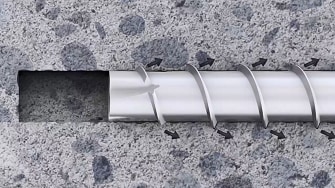
However, this isn’t the only factor contributing to the anchor’s load capacity. For some screw anchors, such as the HUS4-H, extra capacity comes from the friction between the anchor and base material, which is possible thanks to the larger diameter of the shaft compared to the bore hole size.
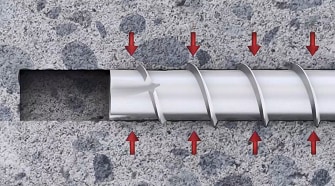
Now that the working is clear, let’s look at why this solution is so highly appreciated by installers. Part of an engineer’s role is to make contractors’ life easier, so it’s interesting to see what benefits screw anchors brings for the site.
Benefit 1: Twice as fast to install
Time is money. The installation speed is by far the most valued upside on the construction site: an expansion anchor requires four steps to be set (drilling, cleaning the hole, hammering, and tightening), whereas a screw anchor only needs three (drilling, cleaning the hole, and screwing) or even just two (drilling and screwing), if covered in the ETA approval. The absence of the hammering step saves valuable time.
Benefit 2: Flexibility over time
Another advantage of this system is the removability of the fixing, by applying a torque moment contrary to the tightening direction. This option makes screw anchors ideal for temporary applications or when a project requires flexibility over its lifetime (e.g. a new layout arrangement in manufacturing facilities).
Benefit 3: Better finishing for better aesthetics
Screw anchors can usually be finished with either a hexagonal head or a countersunk head. Both configurations look better than stud anchors, but the countersunk version in particular is highly appreciated by architects thanks to its flush fixing.
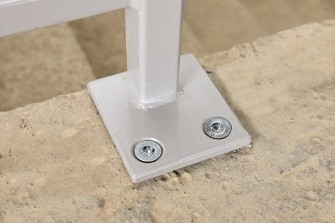
Countersunk head fastenings are used for flush fixings,
providing an aesthetically pleasing finish
Benefit 4: reliability and performance
Engineers care about safety. A common issue with standard expansion anchors is their tightening sensitivity: if the torque applied is higher or lower than required, it can have a significant impact on anchoring resistance. Using a calibrated wrench to apply torque can help, but not always. Screw anchors do not require the use of a torque wrench, but instead can be torqued with a paired screwdriver tool, reducing the risk of an incorrect torque being applied and making your design safer.
You may also be surprised to find that a good screw anchor, such as the HUS-4, can achieve similar or even better loads than many stud anchors.
Applications
Screw anchors are commonly used to fix architectural elements (parapets, handrails, etc.). An effective screw anchor like the HUS4-H can also be used in some structural base plate applications – all you need is PROFIS and, if all the design verification are satisfied, you’ll enjoy the great assets of this technology.
Screw anchors are also used to fasten mechanical and electrical equipment, machinery as well as other serial applications, especially when overhead installation is required.
Keep in mind that screw anchors can only be used for through-fastening installation and may be difficult to use in stand-off applications. In such cases, stud anchors or chemical anchors are recommended.
