
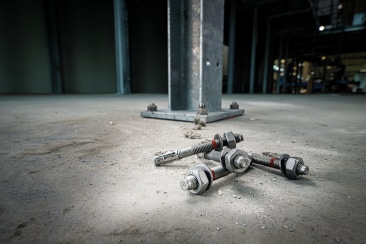
Baseplate designs that are higher performing, Value Engineered, provide more peace of mind, and are more sustainable with HST4 versus other stud anchors
Introduction
In the construction industry, the demand for high-performance anchoring solutions is growing, especially for applications like baseplate fixing, façade brackets, and industrial fastenings. Traditional stud anchors have served well, but they often fall short in terms of performance and design flexibility compared to cast-in or chemical anchors. Enter HST4, Hilti’s latest innovation in stud anchor technology, designed to bridge this gap and deliver performance that matches cast-in headed fasteners.
HST4 is not just another anchor—it’s a game-changer. With its advanced design, HST4 offers higher tensile performance, improved resistance to concrete cone failure, and the flexibility of variable embedment depth. Whether you’re working on a high-rise building, a bridge, or an industrial facility, HST4 provides the reliability and efficiency you need to optimize your designs and reduce costs. 
HST4: The Highest Performing Wedge Anchor
Why Concrete Cone Failure Matters
Concrete cone failure is one of the most critical failure modes for mechanical anchors under tension. It occurs when the concrete around the anchor cracks and breaks out in a cone shape due to the stress induced by the forces transmitted through the fastening point. The design method for calculating the concrete cone resistance of mechanical anchors is provided by EN 1992-4 [1], the European standard for designing fastenings in concrete.
According to EN 1992-4, the characteristic resistance of a group of fasteners in the case of concrete cone failure is calculated by multiplying the characteristic resistance of a single anchor, NRk,c0NRk,c0, by a series of coefficients that account for factors such as edge distance, anchor spacing, and reinforcement density. The characteristic resistance of a single anchor is given by:

For post-installed fasteners, k1 typically assumes values of 7.7 for cracked concrete and 11.0 for uncracked concrete. For cast-in headed fasteners, these values are 8.9 for cracked concrete and 12.7 for uncracked concrete.
HST4 is the first stud anchor in the world to achieve the same concrete cone resistance as cast-in headed fasteners, with a k1k1 factor of 8.9 for cracked concrete and 12.7 for uncracked concrete for select sizes. This means HST4 can achieve the same load capacity as other stud anchors with a shorter embedment depth or a 16% higher load capacity with the same embedment depth.
HST4 is qualified according to the new European assessment documents, EAD 330232-01-0601 v02 [2], which covers the improved resistance to concrete cone failure, and EAD 330232-01-0601 v03 [3], which covers the use of variable embedment depth for mechanical anchors fastened in concrete.
Key Features of HST4
- Turbo-Channels and Interlock: Provides additional interlock resistance with the sleeve, ensuring a secure grip.
- Engineered Sleeve Design: Features a tip groove design and tapered tip for maximum grip and prevention of slippage.
- Turbo-Mountain-Valley Shape: Maximizes sleeve expansion for strong performance in both cracked and uncracked concrete, even under seismic conditions.
- Tailored Top-Coatings: Optimized for tension loads, allowing for close-to-the-edge installation.


Figure 1: HST4’s innovative design delivers unmatched performance.
Variable Embedment Depth: Optimize Your Anchor Length
Flexibility in Design
One of the standout features of HST4 is its variable embedment depth, which allows structural engineers to select the optimal anchor length based on load requirements. Unlike traditional stud anchors, which are limited to fixed embedment depths, HST4 offers a range of embedment depths for each anchor diameter as qualified according to the new European assessment documents EAD 330232-01-0601 v03 [3].

Table 1: Effective embedment depth ranges for HST4
This flexibility not only reduces material costs but also minimizes the risk of hitting rebars during installation, saving time and money on the jobsite.
Unlocking the Power of Value Engineering with HST4
Optimize Baseplate Designs and Total Cost of Ownership
HST4’s higher tensile performance and variable embedment depth enable structural engineers to optimize baseplate designs, reducing both material usage and costs. For example, consider a 10mm thick steel baseplate subjected to a 50kN tensile force in C20/25 cracked concrete. A traditional stud anchor solution would require four M12 anchors with a 165mm spacing, resulting in a 200mm x 200mm baseplate.
With HST4, you have two optimization options:
- Option 1: Reduce the anchor diameter to M10 and the embedment depth to 71mm, maintaining the same concrete cone capacity while reducing material and installation costs.
- Option 2: Maintain the embedment depth but reduce the anchor spacing to 135mm, shrinking the baseplate size to 165mm x 165mm—a 30% reduction in steel volume.
 Figure 2: HST4 enables smaller, more efficient baseplate designs.
More Peace of Mind with HST4: Reliable Installation and Building Safety
Building Safety
Building Safety is a key target of designers globally and at Hilti we are committed to supporting you. We partner with academia and regulatory bodies to define and extend industry standards and elevate practices through education on design methods. We also develop design methods and software to help you design for safety. HST4 is approved for a wide range of load conditions, including static, seismic, and fire loads. By specifying HST4, you can be confident that your designs meet the highest safety standards.
Simplified Installation Steps and Innovative Systems
HST4 is designed for ease of installation, reducing the risk of human error. It’s approved for non-cleaning installation, meaning you don’t need to clean the borehole before installation. Additionally, HST4 can be set using Hilti’s Adaptive Torque (AT) Module, which automatically provides the correct torque for each anchor, ensuring consistent and reliable installation.
More Sustainable with HST4: Reducing Your Carbon Footprint
Sustainable Design Solutions
HST4 helps you reduce the amount of steel used in your designs, contributing to more sustainable construction practices. By optimizing anchor sizes and baseplate dimensions, you can achieve significant CO2 savings. HST4 also comes with documentation to support your project’s environmental standards and green building certifications.
Conclusion
HST4 is the latest innovation in stud anchor technology, delivering performance that matches cast-in headed fasteners. With its advanced design, variable embedment depth, and compatibility with Hilti’s installation systems, HST4 enables you to optimize your baseplate designs, reduce costs, and enhance sustainability.
HST4: The stud anchor that lets you do more with less.
To Know More About HST4
- Hilti PROFIS Engineering Software: Design and optimize your fastening solutions with Hilti’s cloud-based software. Learn More
- SPEC2SITE Page: Explore the our SPEC2SITE Solutions and their applications. Visit Now
References
- European Committee for Standardization. (2018). EN 1992-4:2018 Eurocode 2: Design of concrete structures - Part 4: Design of fastenings for use in concrete. Brussels, Belgium.
- European Organization for Technical Assessment. (2021). European Assessment Document (EAD) 330232-01-0601: Mechanical fasteners for use in concrete. Brussels, Belgium.
- European Organization for Technical Assessment. (2023). European Assessment Document (EAD) 330232-01-0601-v02: Improved resistance to concrete cone failure for mechanical fasteners for use in concrete. Brussels, Belgium.
